The Alhambra: City of History, Power and Faith
By Ainsley Benbow

The Alhambra is an ancient palace, fortress, and citadel complex located in the city of Granada in southern Spain. Peering over the city on a rocky hill, protected by mountains, forests and surrounded by the Darro River, the Alhambra has been witness to political, geographical, social, and economic changes for hundreds of years. Originally built as a fortified royal city, the Alhambra served as a political and ceremonial heart of Muslim Granada for centuries, now being one of the most significant surviving monuments of Islamic architecture in Europe and the only preserved palatine city of the Islamic period. Its red-toned walls, intricate architectural detail, and immersive gardens not only enhance its beauty and attraction for tourists but also reflect the deep history, defensive tactics, and role as a royal residence. Over time, this wonder has continuously played a role in wars, religion, and the ever-changing dynamics in the modern world.
The Alhambra was strategically positioned on the steep, rocky hill of Sabika, overlooking Granada, this was a bot visually dominant and militarily secure choice. There is no historical evidence that the Alhambra was ever intended to be built in a different location, meaning this hill on which it stands was always the intended site. The Sabika hill already held strategic importance as early as the 9th century, when earlier Muslim rulers built small fortifications there, however the Nasrids later expanded on this pre-existing fortified hill, gradually transforming it into the royal palace-city we now know today. Along with its elevated position, allowing rulers to monitor the city below and remain alert in the case of an attack, this placement was also due to other significant factors, including the protection by the nearby Sierra Nevada mountains, the steep terrain, reducing the constant need for more military engagement, and especially, the easy access to the Darro River, supplying reliable water to the complex that was essential to both everyday life and the extensive gardens. This made the fortress a withstandable force against any enemies who would be challenged by other obstacles like camouflage and the terrain before even being able to make it to the palace. This played a crucial role in shaping the Alhambra's function, layout and long-term survival over the next several centuries.
Although the Alhambra’s origins can be traced back to the 9th century, when small fortifications likely existed on the site as stated earlier, it was not until the 13th century that the complex began to take its recognisable form in Granada. The first clear historical references appear in 1238 when Muhammad I ibn al-Ahmar, founder of the Nasrid dynasty, began major construction after establishing Granada as the last Muslim kingdom in Spain. Construction continued for over 250 years, with successive rulers expanding and refining the complex rather than completing it in a single phase, much like the phrase “Rome wasn’t built in a day.” The motivation behind the Alhambra’s creation was both political and symbolic, being designed to protect the ruling family during a time of constant Christian-Muslim conflict, while also reflecting wealth, power, and divine loyalty. At its peak, the Alhambra housed the sultan (Muslim sovereign) and his family, along with hundreds, if not thousands, of servants, guards, officials, craftsmen, and scholars who maintained daily life within its walls.
Although it is often referred to as a palace, it is not a single palace but rather a self-contained royal city covering roughly 35 acres and enclosed by over 2 kilometres of defensive walls. It was divided into clearly defined sections with different social functions, including the Alcazaba, the Nasrid Palaces, the Medina and several small mosques. The Alcazaba was known as the military zone and housed soldiers, guards and watchmen, with space for several hundred troops responsible for protecting the complex. The Nasrid Palaces were the political and ceremonial heart of the Alhambra, where the sultan and his family lived, which was strictly controlled and separated from the rest of the population. Compared to the hundreds and thousands of workers living within the Alhambra, the royal family itself was relatively small, with only a few dozen people, including close relatives and concubines. Additionally, the Medine was a working and residential district containing houses for servants, craftsmen, scholars, administrators and their families, as well as workshops, baths, mosques and ovens. In total, historians estimate that several thousand people lived and worked within the Alhambra at its height, with the vast majority being servants, guards and labourers whose daily routines were shaped by prayer times, court ceremonies and seasonal agricultural work, allowing the Alhambra to work as a fully operational city rather than merely a royal residence.

The design of the Alhambra is deeply rooted in Islamic beliefs, particularly the ideas of Jannah (paradise), balance and Tawadhu’ (humility). Rather than displaying power through monumental size, Islamic architecture focused on intricate detail and spiritual symbolism clearly evident through the palace interiors, walls and statues. The walls are covered in elaborate handmade tilework known as zellige and plasterwork, featuring complex geometric patterns that reflect the infinite nature of God. Arabic calligraphy, often quoting the Qur’an, is carved into walls and arches, most notably “There is no victor but Allah” which was the most common phrase and motto of the Nasrid dynasty. Some researchers have estimated to have found over 3,000 inscriptions of it so far, sometimes appearing in simplified forms like “Only God is victor”, truly reflecting the dedication to religion and commitment to Allah. The Nasrid Palaces contained the most highly detailed rooms, designed for royalty and to impress visitors while reflecting Islamic spiritual ideas and values. Among the most famous is the Hall of Ambassadors in the Comares Palace, the largest room in Alhambra, where the sultan met dignitaries. Its walls and ceiling are covered with intricate stucco work and over 8,000 individual cedar wood pieces arranged in a complex 12-sided star-patterned mosaic. This magnificent wooden dome, often described as a ‘starry sky’ due to the arrangement of white, gold and blue, was meant to represent the seven heavens (or seven levels of paradise) of Islam and the top centre of the structure to be the throne of God. Another notable decorated space is the Hall of the Lions in the Palace of the Lions, known for its marble fountain supported by twelve sculpted lions and surrounded by delicate arches, stucco reliefs and Arabic inscriptions.


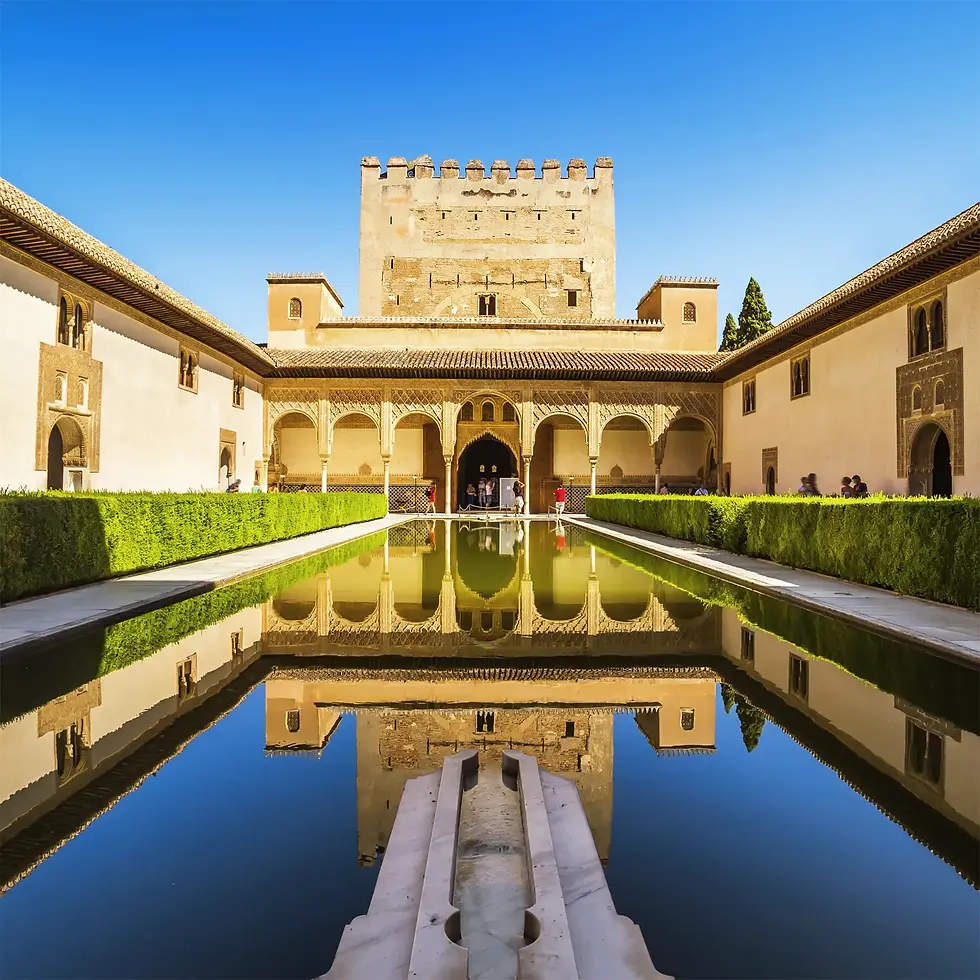
Water also played a central role in the Alhambra’s design, with sophisticated fountains, reflecting pools and channels running through courtyards to symbolise purity and eternal life. Advanced irrigation systems transported water from the River Darro throughout the complex, supporting daily needs and the extensive agricultural gardens housing trees, flowers, fruits and vegetables from all over the world.
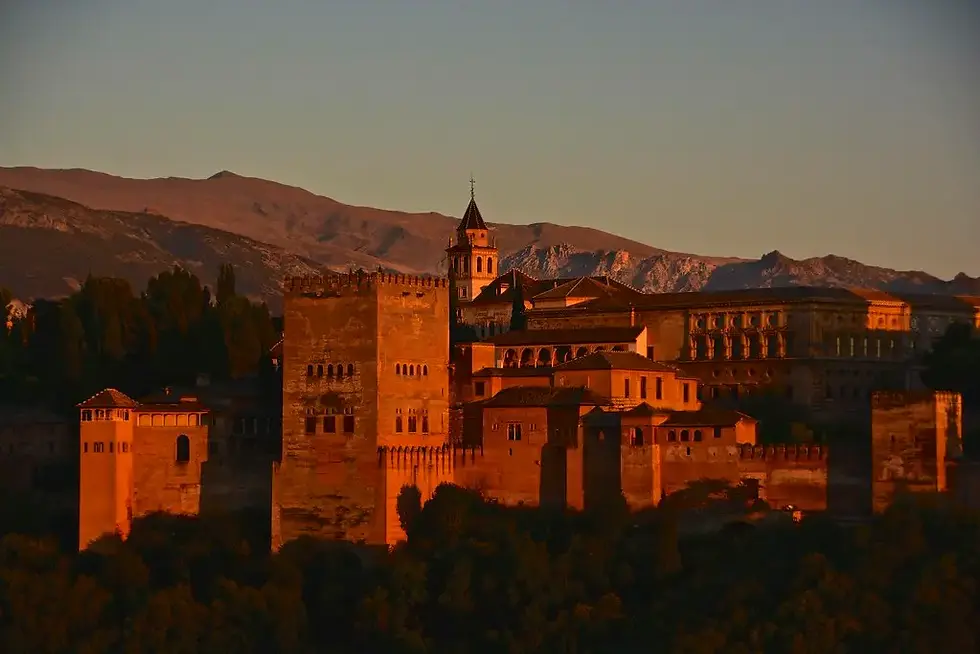
One of the most distinctive features of the Alhambra is its reddish appearance, which directly influenced its name. The word Alhambra derived from the Arabic al-Hamra, meaning ‘The Red One.; This name is generally associated to the colour of the fortress’s walls and towers, which were constructed using local clay-rich earth that naturally produces a warm red and ochre tone when dried and exposed to sunlight. Over time, the colour deepened due to weathering, especially at sunrise and sunset when the entire complex appeared to glow red against the surrounding landscape. Some historians suggest that the name may also have a symbolic meaning, as the colour red held positive associations inIslamic culture, often representing good fortune, protection and power, thereby reinforcing the Islamic architectural principle of harmony between the building and environment.

Further, for centuries, the Alhambra stood in the centre of political struggle during the Reconquista, a long campaign by the Christian kingdom to reclaim territory from Muslim rule. By the late 15th century, the Nasrid kingdom of Granada was isolated and weakened by internal conflict and external pressure. In 1492, after a prolonged siege, the Alhambra peacefully surrendered after the Catholic Monarchs, Ferdinand II of Aragon and Isabella I of Castile, captured Granada, marking the end of Muslim rule in Spain, becoming a royal court for the Christian rulers. While some Islamic features were preserved out of admiration for their beauty, others were altered or destroyed and new Renaissance-style buildings were added, including the Palace of Charles V in the 16th century, along with the addition of numerous paintings and further art pieces, contrasting the rich Islamic buildings and heritage. Over the next few centuries, the Alhambra suffered from neglect, earthquakes and devastating damage during wars, including from the Napoleonic invasion in the early 19th century, when various parts of the fortress were deliberately destroyed and remain fragmented today.

By the late 18th and early 19th centuries, the Alhambra had fallen into severe disrepair, with parts of the complex abandoned and occupied by various squatters. Its international rediscovery began when Washington Irving, an American writer, moved to and lived in the Alhambra for nearly 3 months in 1829. During this time, he resided in the abandoned rooms and was amazed by its beauty and history, inspiring him to write the infamous Tales of the Alhambra in 1832. This romanticised the palace and captured the imagination of European and American audiences, playing a crucial role in raising awareness of the Alhambra’s cultural value and preventing it from falling into further ruin. This renewed interference led to conservation efforts and a growing appreciation of Islamic contributions to European history, allowing the Alhambra to be restored to its former glory and seen for its cultural heritage rather than merely a place of conquest.
Today, the Alhambra is surrounded by the modern city of Granada and was officially recognised as a UNESCO World Heritage Site in 1984, being considered to be one of the most important monuments in Europe. Every year, millions of visitors from around the world come to experience its architecture, gardens, history and beautiful views over the city. Ongoing restoration and conservation projects aim to preserve the fragile materials and intricate decoration for future generations. The Alhambra now stands as a symbol of coexistence, conflict and religion, reflecting both the achievements and complexities of Spain’s past.
Visiting the Alhambra is known to be a deeply moving and immersive experience where visitors are able to walk through the very spaces once inhabited by sultans, courtiers and servants. Due to its popularity, tickets must be booked well in advance, with strict limits on daily visitors. Guided tours are available and highly recommended for valuable historical context and insights; however, many visitors choose to spend their entire day exploring the complex, allowing time to fully absorb in its history, gardens and to merely admire its beauty at a slow pace. While night visits provide a quieter and more exclusive experience that highlights the palace’s subtle lighting and reflective surfaces, day visits allow people to bear witness to the rich red walls and colourful gardens surrounding the palaces - be careful in summer though as the days become very hot and exhausting walking around the large areas and spaces. Even for those unable to enter, Granda offers numerous viewpoints from which the Alhambra can be admired, particularly at sunrise or sunset, when its red walls seem to glow and one can truly be swept away into its mesmerising atmosphere, where centuries of history, architecture and natural beauty come together in a timeless and unforgettable experience.
Bibliography:


