Small Acts, Big Impacts
By Aanya Ahsanullah and Monique Travers
Aanya Ahsanullah – Ecology Captain 2025/2026
Loreto’s Ecology Life
At Normo, I am proud to say that Ecology is not only in the initiatives that we run, but in our daily lives. Every second Monday, JPIC hosts an ecology-focused session, involving presentations, interactive activities, and discussions. We are also proud to celebrate Laudato Si’ Week, Clean Up Australia Day and various other events to raise awareness, promote student voice and make change within our communities while connecting to our school values, particularly Justice and Sincerity.
On top of these important events, sustainability is woven into our daily lives through access to various types of bins, allowing our waste to be sorted properly. Our community service opportunities often involve tree planting or other environmental events, allowing girls to make a difference in an accessible way.
The recycling of our outgoing uniforms through the Loreto Loop, our partnership with recycling company UPPAREL, has allowed our community to make a significant change by reducing textile waste and repurposing our uniforms into usable items, strongly linking to the IBVM call, “live sustainably, discerning what is enough”.
Why Ecology is Important in Today’s World
When writing this article, I was suggested to write about why ecology is important in today’s world.
The answer is simple – there's only one planet we can live on, and it’s Earth.
Our planet is in the perfect position in the solar system so that it’s not too hot, not too cold, and life can thrive in every corner of the planet. We are incredibly lucky, not only to be on this planet but to be the dominant species, meaning we can decide the fate of ourselves. However, in a world of greed, selfishness and destruction, there is so much hope to be celebrated, and that’s what I want girls to be motivated by at Normo. By educating and encouraging people to be involved, we can inspire small change, which eventually snowballs when more and more people step up.
How We Can All Make a Difference – At School and Beyond
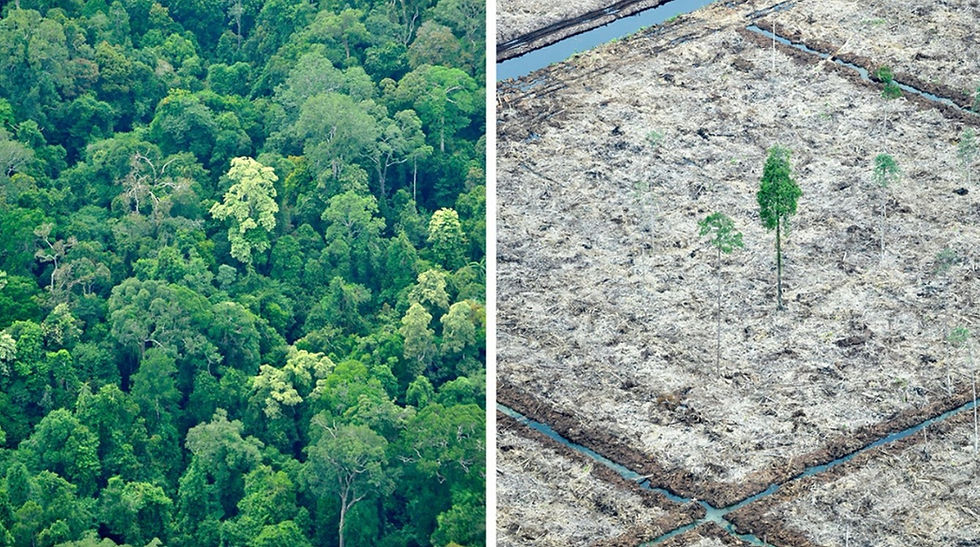
Between 2001 and 2019, Sebastião and Lélia Salgado, a couple in Brazil, planted over 2 million trees to recreate the forest that once existed on their property, and was destroyed due to cattle farming. They restored the ecosystem, which is now thriving with birds, insects and fish.
While it’s not particularly realistic for any of us to plant millions of trees, Sebastião and Lélia Salgado proved to us that individuals can make a difference. We can pick up a piece of rubbish and put it in the bin, and it wouldn’t mean much to us, but that piece could’ve floated into the ocean, a bird’s nest or a wombat hole, having had the potential to seriously harm wildlife.

And, when an increasing number of people participate in small actions like that, it extends the impact much further than we can see. You can make a difference, whether you like it or not!
Monique Travers (Social Justice Captain 2025/2026)
At Loreto, Social Justice is thoroughly ingrained in all that we do and how we live our daily lives. Being one of our five values, we do community service, we are eyes up girls, and we strive to ‘do much’.
But beyond that, Social Justice at Loreto means so much more.
Over the last three terms, I have seen Justice in action; the girls who go above and beyond for change and the girls who let it underpin their everyday work. Justice has gone far beyond a slogan or a one-time action and has become something that is so intrinsic to Loreto that it’s hard to describe the school without it.
We have seen girls begin to understand that justice is not just found in the big campaigns or fundraising totals, but in the quiet, everyday choices that shape our community.
Coming into this year, my goal was to build on the strong sense of justice that already exists within the Normo spirit, but to reground advocacy into something more real by harnessing the joyful and compassionate disposition of the heart that every Loreto girl holds. A justice grounded in faith and lived out daily; one that looks like checking in on a friend, speaking up when something isn’t right, or picking up a piece of rubbish without being asked.
This year especially, we wanted girls to recognise that advocacy is not reserved for a select few. It belongs to every girl, every day, in every action she takes and every belief she chooses to stand up for.
One of the biggest ways we tried to bring this vision to life was through reimagining our annual Caritas Appeal. In previous years, we felt that the true message of Caritas, the call to uphold dignity and go where the need is greatest, was becoming overshadowed by the idea that justice was simply about fundraising. While fundraising is important, we wanted girls to understand the deeper impact of their actions, voices, and solidarity, so we went back to the drawing board.
We began with an assembly that reconnected our community to the “why” behind Caritas Australia. By sharing real stories of communities and young girls whose lives have been transformed, we reminded students of the power they hold to create meaningful change. The heart of the rework was education, ensuring every girl truly understood what she was supporting and the realities faced by these communities, so that her advocacy came from understanding rather than obligation.
From there, the appeal became something much bigger than a single fundraiser. Through partnerships with the Jesuit Refugee Service, Project Compassion boxes within each house, and our School-Wide Walk for Water, girls from Years 5–12 were invited to engage with justice in ways that felt personal and purposeful. The Walk for Water, in particular, became one of the most meaningful moments of the term. Girls walked in solidarity with those around the world who do not have access to clean water, sharing the Caritas message with their families and communities and transforming personal action into wider advocacy.
We ended the term together in our Solidarity Walk for Water, carrying buckets of water around the school grounds in recognition of the many girls across the world who sacrifice their education simply to access something so essential. It was powerful not because it was extravagant, but because every girl understood why she was walking.
And that has been the biggest lesson of this year: when girls understand their power, they step up. By taking the time to educate, connect, and invite girls into justice in a meaningful way, we have seen more students than ever engage with advocacy in a real and lasting sense.
More importantly, though, we saw something far greater: girls beginning to live justice not as an event or slogan, but as part of who they are.
Finally, we had Dr Virginia Small, class of 1977, speak to us during our annual 'Woman of Influence' Evening during International woman's week at the end of last term, and she framed our Mary Ward mission that "Woman in time to come, will do much" in a way that really drills down what we have already said here today, Because woman today will do much, we do not need to wait, because right now is enough.
So, when I think of Social Justice at Loreto, I think of this: the daily efforts, the constant support, and the genuine care that every single girl shows, every single day.
And I think that is what Social Justice at Loreto truly means. It is not found only in large campaigns or extraordinary moments, but in the everyday choices of girls who choose compassion, courage and action. It is the constant support, the willingness to speak up, the quiet acts of kindness, and the understanding that every single person has the power to create change.
Because at Loreto, justice is not just something we do. It has become part of who we are.


